
On faith, waiting, religious expectations and the promises we may never see fulfilled.
Life has a way of making us believe there is something wrong with the wait.
Sometimes, the passage of time makes us question whether we missed something, misunderstood something, made the wrong decision or somehow fell out of favor with God. You watch other people arrive at destinations you have been praying about for years, and before long, you begin to wonder whether there is something wrong with your own journey.
Interestingly, and sadly so, religious people can reinforce this anxiety.
In our eagerness to encourage one another, we sometimes make waiting sound like a problem that requires an immediate spiritual solution. We prescribe more prayers, more fasting, more declarations and sometimes even suggest that a prolonged wait must be evidence of an underlying spiritual problem.
We quote scriptures about faith, remind people of God’s promises and encourage them to hold on. Yet, we sometimes forget the patience of the people whose faith we so readily celebrate.
Perhaps we should revisit Hebrews 11.
The people we celebrate and the timelines we forget
Hebrews 11 is commonly referred to as the Hall of Faith. It chronicles the experiences of people who demonstrated extraordinary faith in God. We celebrate their courage, obedience and conviction. We recount their victories and draw inspiration from their testimonies.
But perhaps we should pay as much attention to what they endured as we do to what they accomplished.
Hebrews 11:13 (KJV) says: “These all died in faith, not having received the promises, but having seen them afar off, and were persuaded of them, and embraced them, and confessed that they were strangers and pilgrims on the earth.”
These all died in faith, not having received the promises.
There is something profoundly uncomfortable about this statement, particularly in a religious culture that places so much emphasis on answered prayers, breakthroughs and visible manifestations.
Think about Abraham. He received a promise that he would become the father of many nations. Yet, he lived through years of waiting. Sarah had to contend with the realities of ageing while holding on to a promise that seemed increasingly improbable by human standards.
Joseph had dreams long before he saw their manifestation. Between the dream and its fulfilment were betrayal, slavery, false accusations and imprisonment.
Moses spent years in the wilderness before leading the Israelites out of Egypt.
These were not people who had no faith. Neither were they people who had somehow failed to discover the secret formula for getting God to move. Their stories remind us that faith and waiting can coexist. In fact, Hebrews 6:12 encourages us to be followers of those who, “through faith and patience inherit the promises.”
Faith and patience. Both are necessary.
Perhaps we have become so accustomed to celebrating the fulfilment of promises that we have forgotten the endurance required to live between the promise and its manifestation.

When waiting becomes uncomfortable
There is a particularly interesting dimension to Abraham and Sarah’s story. In Genesis 16, we encounter their decision to introduce Hagar into the equation. God had made a promise, but time was passing. Sarah was ageing. The circumstances appeared increasingly unfavourable. The promise was still there, but its fulfilment seemed less likely with each passing year.
They decided to do something about it. The consequences of that decision would extend far beyond the immediate circumstances that prompted it. I find this part of their story particularly instructive because it reveals something about human nature. We can believe in a promise and still become uncomfortable with the process through which we expect it to materialise.
Sometimes, waiting makes us anxious enough to manufacture outcomes. We take shortcuts. We compromise. We settle for alternatives. We make decisions based on the urgency of our circumstances rather than the wisdom required to navigate them.
There is a difference between taking responsibility and attempting to force an outcome. Patience does not mean doing nothing. Neither does faith require us to suspend our judgement. We must continue to prepare, learn, make decisions, take appropriate action and exercise discernment.
The challenge is knowing when we are acting responsibly and when we are simply trying to relieve ourselves of the discomfort of waiting.
Our impatience has become religious
I sometimes wonder whether we have inadvertently created a culture in which people are allowed to wait, provided they do not wait for too long.
We celebrate the wedding but rarely acknowledge the years of waiting. We celebrate the birth of a child but seldom appreciate the emotional journey that preceded it. We celebrate the promotion without considering the years someone spent being faithful in seemingly insignificant assignments.
And when someone’s waiting becomes prolonged, we start looking for explanations.
Perhaps they are not praying enough. Perhaps they need to sow a seed. Perhaps there is a spiritual blockage. Perhaps they are doing something wrong.
Of course, there are circumstances in which reflection, correction and a change of direction are necessary. Faith does not require us to ignore reality or refuse to examine our decisions. But we must be careful not to turn every delay into a diagnosis.
There is an uncomfortable tendency to equate speed with divine approval and delay with spiritual deficiency. We want to give people hope, but sometimes we also give them deadlines. We encourage people to trust God, provided the waiting does not become too long or inconvenient. Who determines these reasonable timelines? Reasonable to whom? Perhaps we need to be more careful about the conclusions we draw from circumstances we do not fully understand. #Selah
The psychology of waiting
Beyond the spiritual implications, waiting has a psychological dimension that deserves attention.
Waiting can be exhausting. #Phew!!!
It can produce anxiety, uncertainty, envy, self-doubt and emotional fatigue. Repeatedly hoping for something that has not materialised can affect how we see ourselves, our circumstances and even our future.
Consider the person who has spent years hoping to get married. Or the couple hoping for a child. The professional who has remained in the same position despite years of preparation and hard work. The family waiting for a breakthrough in circumstances that seem beyond their control.
These experiences are not interchangeable, but they share an important human element: the difficulty of living with an uncertain outcome.
And sometimes, other people’s testimonies make the experience even more complicated. Someone else’s answered prayer can become an unintended reminder of our unanswered one. We may genuinely celebrate them while privately wondering when our own turn will come.
This is why we must be careful about how we encourage people.
Patience does not mean the absence of emotional discomfort. Faith does not require us to pretend that disappointment does not hurt. Sometimes, the most helpful thing we can offer someone is companionship without unsolicited interpretation.
We do not always need to explain why someone is still waiting.
What if the promise is not fulfilled in our lifetime?
This, to me, is perhaps the most sobering lesson in Hebrews 11.
The chapter does not end with everyone receiving everything they had hoped for. Hebrews 11:39–40 (KJV) says: “And these all, having obtained a good report through faith, received not the promise: God having provided some better thing for us, that they without us should not be made perfect.”
Let’s pause and think about the implications.
These people obtained a good report through faith, yet they did not receive the promise.
Their inability to see the promises materialise did not invalidate their faith.
This challenges the way we sometimes tell our stories.
We have become accustomed to presenting testimonies as narratives with neat endings: there was a problem, we prayed, God answered, and here is the evidence.
But what happens when the story does not conclude that way?
What happens when someone remains faithful but does not get married? When the long-awaited child never arrives? When the career opportunity never materialises? When someone dies believing in a promise they never personally experience?
Do we have room in our theology and our conversations for such people? Can we honour their faith without inventing explanations for their circumstances? Can we acknowledge that a person’s life can be a testimony of faith even when it does not provide the conventional evidence of a breakthrough?
I think we should. TBH, I think we must.
There is a difference between inheriting a promise and personally witnessing its fulfilment.
Hebrews 11:39–40 also introduces a generational dimension to faith. The writer connects the experiences of earlier witnesses with something God was bringing to completion across generations.
This invites us to consider that the significance of some promises may extend beyond the lifetime or immediate experience of the person who first received them.
What if some things we are believing for are not exclusively about us?
What if our responsibility is sometimes to prepare the ground for people who will experience what we only had the privilege of anticipating?
Perhaps this is another way of thinking about legacy. #Liiisssssttteeeennnnn
The responsibility of those who encourage others to wait
There is something else I think we need to examine.
How do we treat people who are waiting? It is easy to encourage patience when we are not the ones experiencing the uncertainty. It is easy to quote scriptures when we are not the ones confronting the disappointment.
We should be careful about assigning spiritual explanations to circumstances we do not understand. We should resist making people feel responsible for outcomes beyond their control. We should stop using other people’s testimonies as benchmarks against which their faith must be measured.
We must also recognise that encouragement can become another form of pressure when it leaves no room for honest emotions.
Sometimes people need to be reminded of God’s promises. Sometimes they need practical assistance. Sometimes they need to reconsider their approach. And sometimes they simply need someone who will sit with them without making their circumstances a subject of spiritual investigation.
Our responsibility is not to manufacture explanations for everyone else’s timeline. It is to exercise compassion, discernment and wisdom in how we respond.
Who are we becoming while we wait?
Perhaps one of the things we should pay closer attention to is who we are becoming while waiting for the things we desire. #Becoming
Does waiting make us bitter, envious and preoccupied with other people’s timelines? Does it make us question our worth or lose our ability to appreciate the things we already have?
Or can it teach us endurance, contentment, discernment and a deeper understanding of faith?
This is not an argument for romanticising hardship or pretending that waiting does not hurt. Some seasons are lonely. Some disappointments are devastating. Some prayers are difficult to keep praying. And it is perfectly human to experience grief, frustration and uncertainty along the way.
Faith does not require us to pretend that the wait is easy. (Perhaps) It requires us to keep trusting even when it isn’t.
We should also remember that patience is not an instruction to remain indefinitely in circumstances that require action, correction or change. We must be willing to examine our decisions, recognize opportunities and take responsibility for the things within our control.
There is wisdom in knowing when to wait, when to act and when to change direction.
Perhaps we need to rethink the wait
Life will sometimes make you feel that there is something wrong with the wait. People may make you feel that way, too. Even religious people, with the best intentions, may unintentionally make you question your timeline.
But perhaps we need to revisit the experiences of the patriarchs and the other witnesses of faith.
We need to remember that some journeys take longer than we anticipated, some promises unfold differently than we imagined, and some things we hope to see may require us to trust beyond what we can presently see.
The wait is not automatically evidence that something has gone wrong. We should stop measuring the validity of people’s faith by the speed with which their circumstances change. Hebrews 11 does not merely give us a catalogue of people who received promises. It gives us an account of people who lived and died believing.
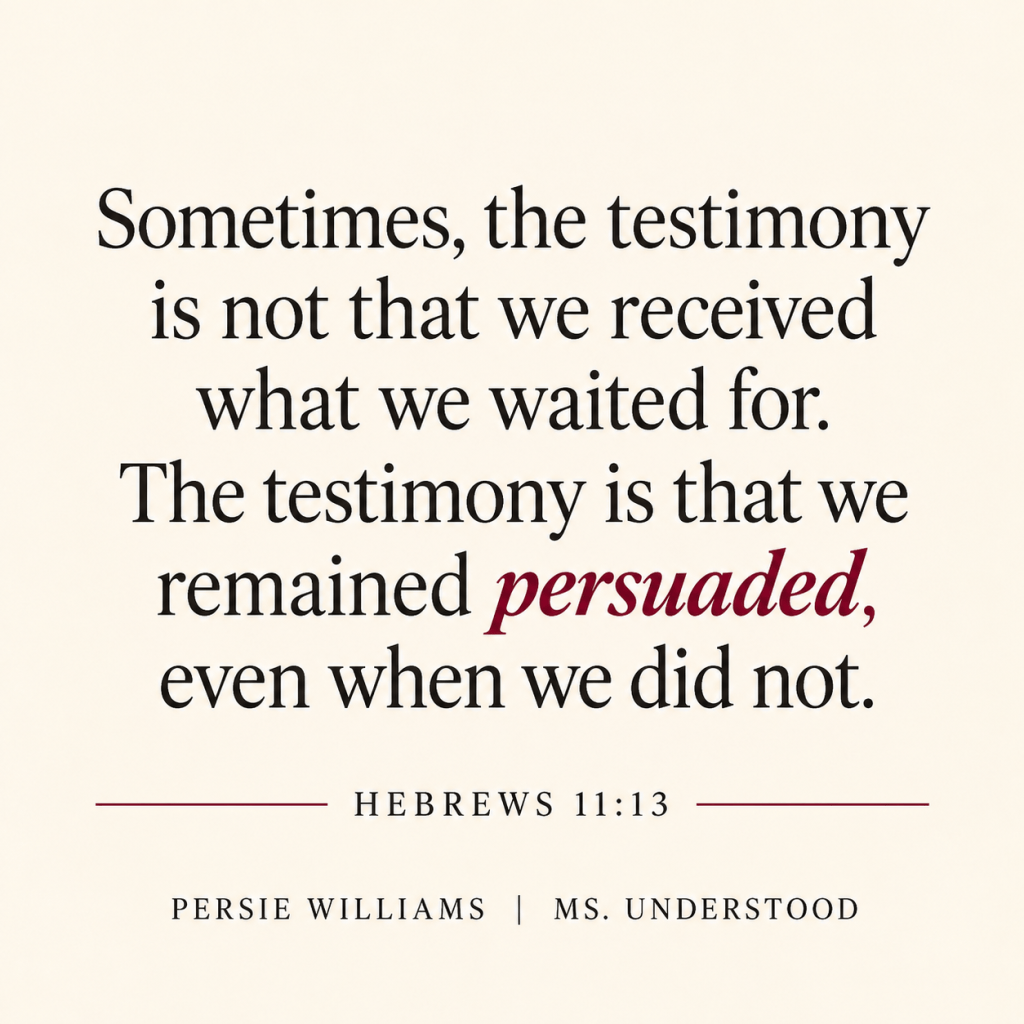
Sometimes, the testimony is not that we received what we waited for. The testimony is that we remained persuaded, even when we did not.
Perhaps we have become so preoccupied with receiving the promise that we have neglected to understand the responsibility of believing, waiting and living faithfully. #Sigh
May we learn to appreciate the patience of the patriarchs, extend grace to those whose timelines differ from ours and resist the temptation to turn every prolonged wait into a spiritual investigation. (Amen)
After all, faith and patience are both part of the inheritance.
— Persie Williams
Ms. Understood

Please shAIR Your Thoughts :-)