
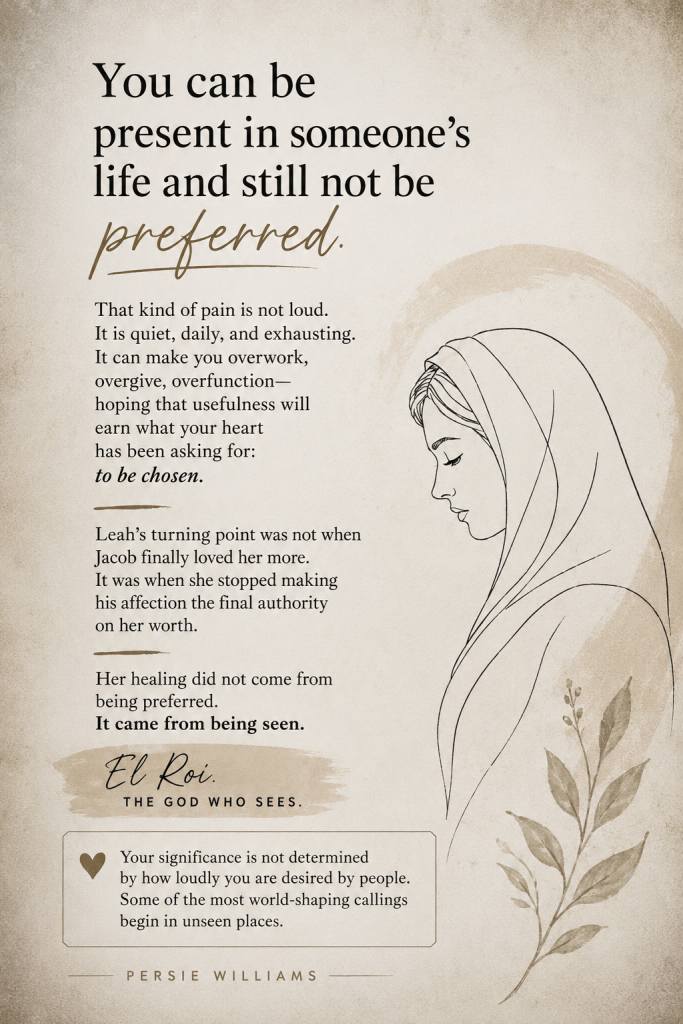
There are people who enter rooms and are immediately chosen. And then there are people like Leah. Overlooked. Compared. Tolerated. Present but not preferred.
In The Bible, Leah is introduced with a sentence that has quietly wounded readers for generations: “Jacob loved Rachel more than Leah.”
And for many people, that sentence feels painfully familiar. Because some people know what it means to live adjacent to affection. To be useful but not deeply desired. Included, but emotionally unseen. Needed, but not emotionally safe.
This is what makes Leah’s story one of the most quietly heartbreaking stories in Scripture.
Leah Did Not Just Lose a Husband’s Affection
She may have lost her sister too. Rachel and Leah were sisters before they became rivals. Before Jacob, there may have been shared girlhood, shared memories, shared dreams about marriage and family. Then suddenly, affection became unevenly distributed.
Rachel became the beloved, and Leah became the tolerated wife. And unequal affection changes the emotional atmosphere of everything. Every smile becomes loaded. Every interaction becomes comparison. Every gesture becomes interpreted. Who is loved more? Who receives tenderness? Who gets protected? Who is desired differently?
One of the most heartbreaking moments in Leah’s story happens when Jacob prepares to meet Esau. He arranges his family strategically: the servants first, Leah and her children next, Rachel and Joseph last; closest to him and therefore safest. That arrangement revealed something Leah had probably known for years. Preference has an order. And imagine what that must have felt like. To walk toward possible danger while simultaneously confronting your emotional position in someone’s heart.
The Emotional Exhaustion of Staying
There’s a tendency in today’s parlance, to approach Leah’s story with modern assumptions. “Why didn’t she leave?” “Why didn’t she choose herself?” “Why didn’t she start over?” We forget that Leah lived inside a world where marriage was tied to survival, economics, identity, family structure, and social standing. She could not simply walk away. She had to remain inside the very environment producing the wound.
That kind of emotional exhaustion changes people. And perhaps that is why Leah’s story still resonates so deeply today. Not because most people understand polygamy, but because many understand what it means to remain inside emotionally unequal environments. Some people know what it feels like to:
- stay loyal where they are not celebrated,
- remain useful where they are not emotionally safe,
- continue serving while internally starving for tenderness.
Many high-functioning people quietly survive rejection by becoming indispensable. They become:
- reliable,
- productive,
- emotionally intelligent,
- strong,
- deeply supportive,
- endlessly useful.
Not always because they are healthy but because usefulness can feel safer than rejection. “If I carry enough… serve enough… love enough… help enough… perhaps I will finally become impossible to overlook.”
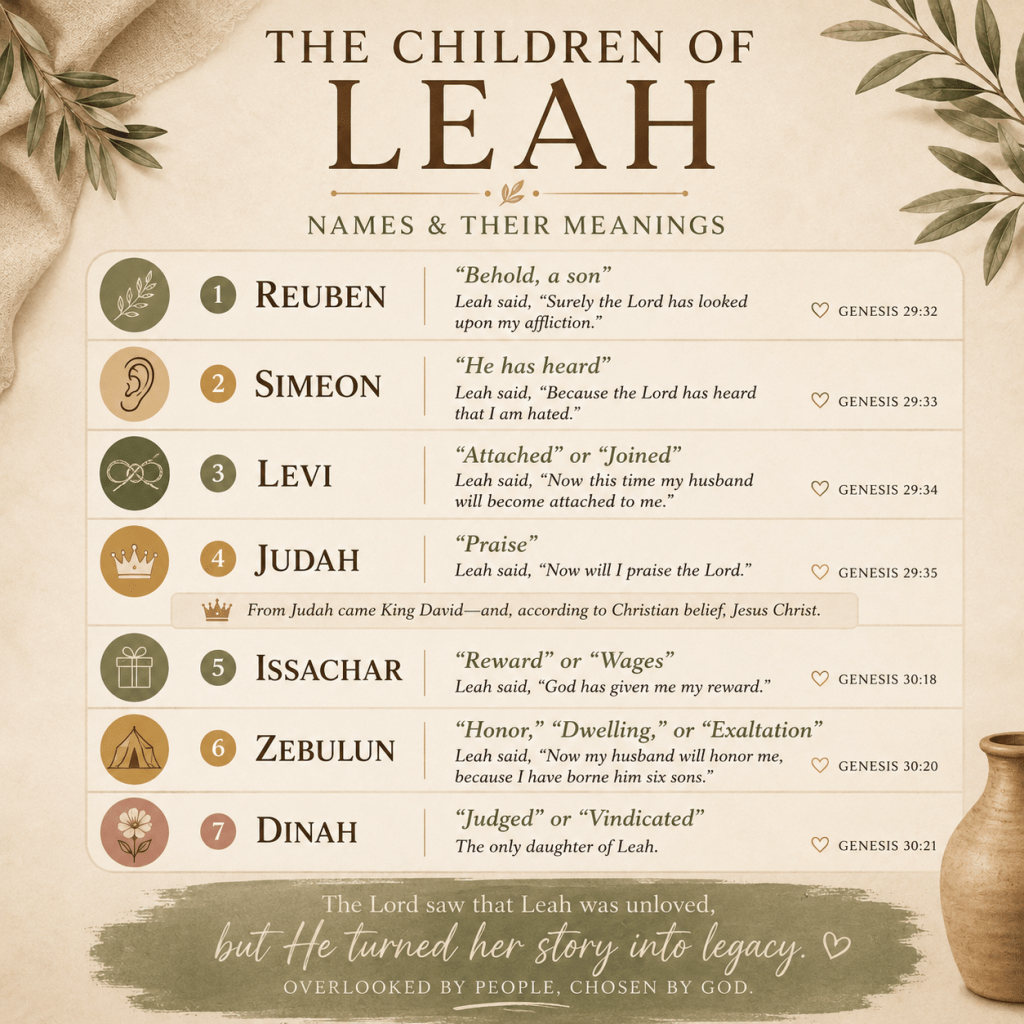
And perhaps this is why Leah’s children’s names feel so emotional. The names she gave her sons were not random. They were emotional journal entries.
Reuben – “Behold, a Son” “Surely the Lord has looked upon my affliction.” ~ Maybe now I will finally be seen.
Simeon – “He Has Heard” “The Lord has heard that I am unloved.” ~ God heard what people ignored.
Levi – “Attached” “Now my husband will become attached to me.” ~ Maybe this time I’ll finally ‘be’ enough.
The sentiment behind that name exposes something deeply human: the temptation to earn love through usefulness, and many people still live there. “If I achieve more… perform better… become indispensable… Perhaps then I’ll finally be loved correctly.”
One of the saddest possibilities in Leah’s story is the likelihood that her fruitfulness was partly survival. Productivity became the vehicle through which she searched for worth. This pattern from biblical times also occurs in the present day, where entire identities quietly form around emotional deprivation. Some people spend their whole lives earning usefulness because they never felt safely chosen. (Trauma Responses Galore)
Leah’s Turning Point
By the time Leah gave birth to Judah, her language shifted. Not toward Jacob but toward God.
“Now will I praise the Lord.” ~ No bargaining. No striving. No emotional negotiation. Just praise. This highlights one of the deepest moments in Leah’s story. Scripture never really mentioned anything about Jacob’s emotional transformation or attitude change. Leah’s circumstances may not have dramatically changed. But it seems like Leah did.
Somewhere inside grief, comparison, disappointment, and emotional exhaustion, she slowly stopped making Jacob’s affection the final authority on her worth. Not because human love stopped mattering. But because she realized human preference, while painful, is not ultimate. Not out of bitterness but more out of liberation.
Not: “Now I will finally be loved.”
But: “Even if I am not loved the way I hoped, I will still praise.”
And perhaps that is maturity: when another person’s inability to fully see you no longer becomes the foundation of your identity.
Rachel Was Not Entirely Free Either
In fairness to Rachel, being preferred can become its own prison. At the centre of it all, Rachel carried comparison, rivalry, infertility for years, pressure tied to beauty and desirability, fear of losing affection. In many ways, both sisters suffered under a system that reduced women into competition for love, visibility, and survival. Which makes the story even more tragic. Because patriarchy did not merely wound Leah. It wounded the entire family structure.
Heaven Often Builds Through the Overlooked
In all of this, somehow, Leah’s story does not end in irrelevance. Ironically, history remembered Leah differently than her pain predicted. Through Leah came Judah. Through Judah came kings. And through that lineage came Jesus Christ. Meanwhile, through Levi came the priesthood. The woman who felt unwanted became the mother of priests, kings, and the messianic line. History remembered Leah differently than people treated her. And this pattern appears throughout Scripture.
- Joseph was rejected by his brothers.
- David was overlooked by his father.
- Moses began as an exile.
- Gideon called himself the weakest in his house.
And Leah? Leah was unloved. But God repeatedly chooses people mislabelled by history because Heaven is not governed by human ranking systems. People measure charisma whereas God measures calling. People notice beauty, God studies burden. People choose based on visibility. God chooses based on purpose.
The Deeper Confrontation Hidden Inside Leah’s Story
It would be incorrect to treat Leah’s story as only about rejection because it’s also about identity. At its root, it addresses what happens when human beings begin emotionally negotiating for worth. Many people spend years trying to earn from people what cannot ultimately be secured through performance. Romantic validation. Parental approval. Career success. Public recognition. Social preference.

Furthermore, Leah’s story quietly asks: “What happens when being chosen by people becomes too central to our understanding of value?” This distinction is key because significance and preference are not always the same thing. Some people are deeply preferred and leave little legacy. Others are quietly overlooked while carrying generations inside them. Leah spent much of her life asking: “Will someone finally choose me?” But history ended up answering a different question entirely: “What happens when God chooses someone people overlook?”
The answer was: Priests. Kings. Legacy. Redemption history. Not because Leah was the most celebrated woman in the room; but because God saw what others failed to value. One of the softest verses in Leah’s story may also be one of the loudest: “When the Lord saw that Leah was unloved…”
He saw it. El Roi. The God who sees.
And being seen is where healing begins for many people. Not in pretending rejection does not hurt. Not in denying the ache of unequal love. Not in becoming emotionally numb. But in realizing that being overlooked by people is not the same thing as being unseen by God. Some of the most world-shaping callings begin in unloved places.
— Persie Williams

Please shAIR Your Thoughts :-)